Artificial Intelligence for Seminaries & Theological Institutions
What does your institution’s future look like when artificial intelligence shapes how students learn, faculty teach, and ministers serve? We help seminaries, divinity schools, and theological institutions navigate AI with theological integrity, ethical clarity, and missional purpose — from strategic planning to practical implementation.
A Values-First Approach to AI in Theological Education
Rather than beginning with technology and asking “what can this do?”, we begin with theology and ask “who are we called to be?” — then build AI strategy around that answer.
Assess Your Readiness
Conduct strategic leadership sessions exploring how AI concepts, trends, and innovations intersect with your theological mission and institutional identity.
Develop Mission-Aligned Strategy
Build a strategic roadmap that aligns AI adoption with your institution’s theological distinctives, educational goals, and formational commitments.
Equip Faculty & Students
Use AI to augment — not replace — the work of theological education. Empower faculty with practical tools and students with critical AI literacy for ministry.
Navigate AI for Research
Provide hands-on guidance for deploying AI in biblical studies, theological research, language learning, and academic publishing with integrity.
Create Tailored Policies
Craft comprehensive AI policies for students, faculty, and staff that provide clarity on academic integrity while leaving room for faithful innovation.
Lead Through Change
Prepare your community to engage AI tools with wisdom and discernment, fostering a culture of theological reflection alongside technological adoption.
Not sure where to start? Every institution’s AI journey is unique.
Schedule a Free ConsultationWe’re working with seminary leaders to demystify AI while maintaining the theological depth and relational formation essential to ministry preparation. That means involving the right people, grounding decisions in mission, and planning for the uses of AI that will have the greatest impact on your institution’s calling.
Comprehensive Support for Your AI Journey
From initial conversations to deep implementation, we meet your institution where you are.
| Getting Started with AI Foundations & Visioning | Deploy & Implement Policy & Training | Develop Custom Solutions Deep Integration |
|---|---|---|
| Facilitating interactive workshops and brainstorming sessions for faculty, staff, and leadership | Evaluating current technology platforms and AI capabilities across your institution | Developing AI-integrated pedagogy for biblical studies, homiletics, and pastoral theology |
| Exploring the theological and ethical implications of AI for your tradition | Creating detailed implementation plans with timelines, resource allocation, and success metrics | Building frameworks for AI-assisted theological research with academic integrity |
| Planning for workforce and faculty development implications | Designing and delivering AI literacy training programs for faculty cohorts | Creating AI-enhanced student advising and formation assessment tools |
| Establishing data privacy, academic integrity, and ethical use protections | Drafting student, faculty, and administrative AI use policies | Developing case study curricula for pastoral AI ethics in congregational settings |
| Assessing current AI literacy and identifying areas for growth | Integrating AI literacy across the theological curriculum | Building denominational or network-wide AI guidance frameworks |
| Creating an AI roadmap based on institutional mission and theological priorities | Preparing students to bridge the seminary/sanctuary AI divide | Designing board and trustee education programs on AI implications |
Six Scenarios from the Frontlines
Real tensions emerging where theological education meets ministry practice. Click any scenario to explore the full complexity, stakeholder perspectives, and questions for discernment.
01
The Grading Double Standard
A student complains about her professor using AI to grade her paper — while students face academic integrity violations for using AI themselves.
Explore scenario →
Context
Maya, a graduating M.Div. student, receives feedback on her 20-page Trinitarian theology paper. The comments are thorough but clearly algorithmic — uniform tone, similar sentence structures, generic praise like “This demonstrates good engagement with the material.” An AI detector confirms her suspicion.
The Complaint
“Students face academic integrity violations if we use AI for writing, but Professor Johnson uses AI to grade our papers? If AI can’t authentically represent my theological thinking, how can AI authentically assess it? I spent six weeks on this paper, and a bot read it in 30 seconds.”
Added Complexity
- The professor teaches 65 students across three courses on overload
- The seminary’s AI policy prohibits student use but is silent on faculty use
- Other students appreciate the faster turnaround and detailed feedback
- The professor argues AI lets them give more feedback than humanly possible
Questions for Discernment
- Is there a meaningful difference between student AI use for writing and faculty AI use for assessment?
- What does formation require in terms of human feedback and evaluation?
- How should policies address faculty use of AI, not just student use?
- Would disclosure change the ethical calculus?
- How do institutional workload issues relate to AI ethics?
02
The Field Education Disconnect
A student is caught between a tech-savvy supervisor teaching AI as essential ministry skill and a seminary professor who rejects it as inauthentic.
Explore scenario →
Context
Marcus’s field supervisor, Pastor Jennifer, has integrated AI throughout her ministry — newsletters, pastoral care drafts, Bible study questions, sermon research — and teaches Marcus these tools as “essential ministry skills.” Meanwhile, Dr. Williams, his seminary field education professor, emphasizes “authentic pastoral voice” and “incarnational presence.”
The Tension
When Marcus submits a learning covenant including AI-assisted ministry skills, Dr. Williams rejects it: “Field education is about forming your pastoral identity, not learning to outsource ministry to algorithms.” Marcus’s supervisor gives him a strong evaluation; his professor gives him a mediocre seminar grade for being “overly reliant on technology.”
Added Complexity
- The congregation’s giving and engagement have grown since adopting AI tools
- Marcus is discerning a call to church planting, where efficiency matters for survival
- Dr. Williams is a 30-year veteran of pastoral ministry who’s never used AI
- The seminary has no clear guidance on AI use in field education
Questions for Discernment
- Who determines what counts as “essential ministry skills” for formation?
- How do seminaries bridge the gap between non-using faculty and AI-using supervisors?
- What ministerial competencies are non-negotiable regardless of technological change?
- How should field education adapt when congregational practice outpaces seminary preparation?
- What’s the relationship between efficiency and faithfulness in ministry?
03
The Denominational Training Paradox
Three recent graduates with completely different AI preparation — none, detection-only, theory-heavy — all arrive at ministry feeling unprepared.
Explore scenario →
Three Graduates, Three Gaps
Carla received zero AI training under strict prohibition policies. Her denominational office now requires AI for grant writing and communications — she had to learn through 20 hours of paid denominational training and feels theologically unprepared to discern appropriate use.
James attended optional workshops focused entirely on detection and avoiding plagiarism. His congregation expects tech savvy. The board just asked him to implement an AI chatbot for member questions. He has no idea where to start.
Aisha graduated from a progressive seminary that integrated AI ethics across the curriculum but offered minimal skills training. She can articulate sophisticated critiques of algorithmic bias but can’t actually use the tools. Her supervising pastor thinks she’s “all theory, no practice.”
The Realization
All three feel unprepared, but in different ways. Their expensive seminary education didn’t equip them for the technological realities of ministry. Meanwhile, denominational leaders seem baffled that seminaries aren’t teaching these “obvious” skills.
Questions for Discernment
- What’s the appropriate division of labor between seminaries and denominations for AI training?
- Can theological education provide both deep ethical formation AND practical skills?
- What core competencies should ALL graduates have, regardless of ministry setting?
- How can denominations and seminaries collaborate rather than contradict each other?
04
The Sermon Authenticity Crisis
A D.Min. cohort fractures over whether AI-assisted sermon preparation preserves or undermines authentic proclamation of the Word.
Explore scenario →
Context
At a D.Min. intensive, Rev. Thomas casually mentions using AI to generate sermon outlines weekly: “I input the lectionary, my tradition, congregation context. It gives me three outlines. I pick one, add stories and local application — done in half the time.”
Rev. Sarah is horrified: “The sermon is the pastor’s authentic proclamation of the Word. Using AI is like having someone else pray for you — it defeats the entire purpose. That’s algorithmic mimicry.”
Rev. Thomas pushes back: “I use commentaries, sermon databases, illustrations from other preachers. How is AI different? My congregation has grown, engagement is up, and I have more time for pastoral care.”
Rev. Kim quietly admits she’s been using AI for months in shame — but her preaching has actually improved, and she’s less anxious.
The Faculty Dilemma
The homiletics professor wants to add a module on “AI and Authentic Proclamation” warning against use. The practical theology professor wants to teach effective AI collaboration. The dean wonders about prohibiting AI in D.Min. sermon assignments — but how would they enforce it?
Questions for Discernment
- What makes a sermon “authentic”? Can AI assistance preserve authenticity?
- How is AI different from traditional sermon prep resources?
- Should outcomes matter in evaluating AI use in preaching?
- Is there a difference between AI for brainstorming vs. drafting vs. final text?
- How do we assess homiletical competency in an AI era?
05
The Pastoral Care Algorithm
A church implements 24/7 AI pastoral care. A recent M.Div. graduate struggles with what it means for their role, their training, and their calling.
Explore scenario →
Context
A large urban church partners with a tech company to pilot a 24/7 AI pastoral care system. Members text concerns and receive immediate responses trained on pastoral care literature, theology of suffering, and crisis protocols. Urgent cases (suicidal ideation, abuse, medical emergency) are immediately escalated to human pastors.
What Alex Discovers
- 60% of pastoral care requests now go to the AI first
- Members report satisfaction with immediate response vs. waiting for callbacks
- The AI has identified three serious crises and connected people to help faster than the previous system
- But some members feel the church is “replacing human compassion with machines”
- And Alex feels their pastoral care training is being devalued — therapeutic listening skills replaced by system management
The Seminary Response
When Alex contacts their seminary, the pastoral care professor is appalled and calls it “technological replacement of incarnational ministry.” The practical theology professor is intrigued and asks Alex to present on it as innovation. No one has actually examined the system or talked to members who’ve used it. The seminary has no framework for evaluating such innovations.
Questions for Discernment
- What aspects of pastoral care can — and cannot — be mediated by AI?
- How do we weigh efficiency and accessibility against embodied presence?
- What theological anthropology is at stake?
- Should seminaries prepare students for these systems, or to resist them?
- What’s lost and what’s gained when AI provides first-response pastoral care?
06
The Admissions Algorithm Dilemma
A seminary system considers AI for admissions and recruiting. The pilot results are genuinely mixed — and the bias concerns are serious.
Explore scenario →
Context
A denominational seminary system facing enrollment decline considers an AI-driven admissions system that predicts “ministry success,” identifies high-potential candidates from non-traditional backgrounds, personalizes recruiting and aid offers, and flags students likely to need academic support.
Mixed Pilot Results
- The AI identified strong candidates (career changers, non-traditional educational backgrounds) who would have been rejected under old criteria
- First-year retention improved at the pilot school
- But the AI consistently scored candidates from certain denominations and regions lower — algorithmic bias reflecting historical data
- Some faculty are uncomfortable: “calling isn’t algorithmic”
- The system recommended denying a student with learning disabilities based on predicted struggle — a student whose pastor strongly advocated for them
The Debate
Dean Martinez: “This is just data-driven decision-making. We already use GPAs and test scores. This is more holistic and caught candidates we’d have missed.”
Dean Johnson: “We’re reducing vocational discernment to an algorithm. What happened to communal discernment of call? And the bias issues are serious.”
Dean Patel: “Can we afford NOT to use every tool when our schools are struggling? But we need to fix the bias problems.”
Students are unsettled: “If an algorithm predicted our success, does that mean our calling was validated by a machine? What if we’d been scored ‘low probability’?”
Questions for Discernment
- What role should predictive analytics play in admissions to theological education?
- How do we balance institutional sustainability with theological commitments about calling?
- Can algorithmic bias be adequately addressed, or are some uses fundamentally incompatible with equity?
- What’s the difference between data informing decisions and algorithms making them?
- What transparency do applicants deserve about how AI is used in decisions about them?
Connect with an AI & Theological Education Expert
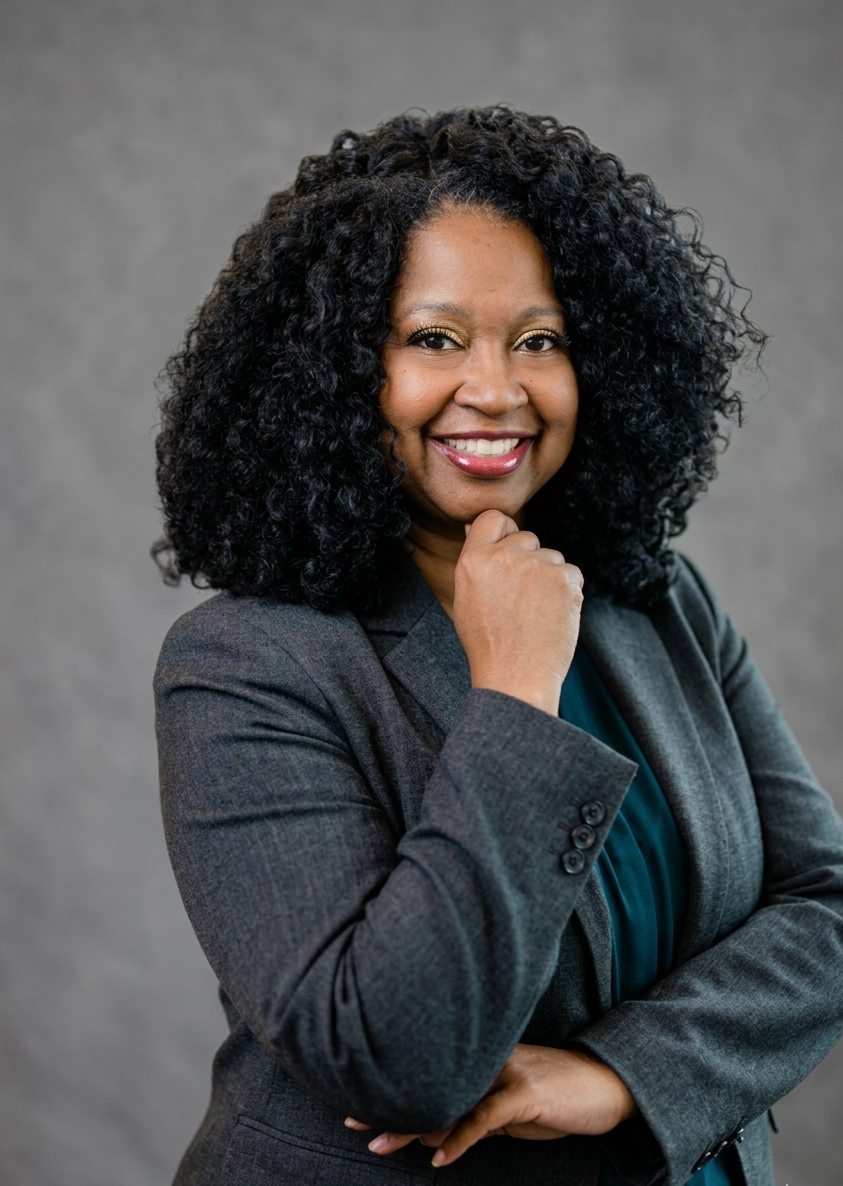
Elonda Clay, B.S., MLIS, M.Div
With a unique background spanning theology, education, and emerging technology, I help seminary and divinity school leaders navigate the complex intersection of AI and theological formation. My work is rooted in the conviction that technology should serve the church’s mission — never the other way around.
I partner with institutions across denominational lines to build AI strategies that honor theological identity, strengthen pedagogical practice, and prepare students for ministry in an increasingly AI-shaped world. From half-day workshops to comprehensive policy development, every engagement begins with your institution’s mission and values.
I’m available for on-site and virtual consultation, conference keynotes, faculty development retreats, and denominational convenings.